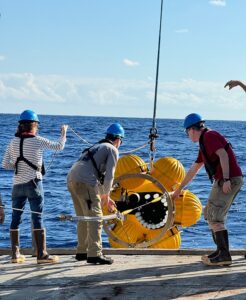
OFP Sediment Trap Deployment
Credit: Olivia Gadson
Forty-seven miles southeast of Bermuda in the Sargasso Sea, the Oceanic Flux Program (OFP) mooring observatory continues to build the world’s longest uninterrupted time-series particle data study. Spanning nearly five decades, the project led by the Marine Biological Laboratory (MBL) and the Bermuda Institute of Ocean Sciences, features samples collected by three McLane Sediment Traps sampling at three different depths every two weeks.
This unique, decades-long time-series has contributed directly and/or conceptually to numerous scientific investigations that have improved our understanding of ocean biogeochemical cycles. The OFP provided the first direct evidence for seasonality in the deep ocean and the tight coupling between deep fluxes and upper ocean processes.
The Sediment Traps constantly catch the sinking particles of sediment, microplankton shells, detritus, and pollutants that drift down into the deep ocean, shaping how scientists model climate change, nutrient cycling, and deep-sea ecology.
Learn more about the OFP program.
Learn more about Sediment Traps.